Structured Literacy · Dyslexia Intervention · Grades 2–12

Every long word has a pattern. I teach students to find it.

rō|bŏtV/CVnăp|kĭnVC/CVinfra+struct+ureroot: struct = build

I am a Texas educator with ten years in K–12 classrooms, most recently as a Dyslexia Teacher at Alvin ISD. I deliver explicit, multisensory structured literacy to students from second grade through high school, and I use each day's data to decide what to reteach.

Reading by Design, Dyslexia Intervention SpecialistScience of ReadingProvider of Specially Designed Literacy Skills InstructionSpecial Education 7–12Generalist 4–8Social Studies 7–12
Illustration of Ms. Freeman in a school hallway holding a binder
Ms. FreemanSmall groups, 2–6 students, 30 to 45 minutes, every day.
How I teach

Eight components, taught the same way every day

Each lesson covers the components of dyslexia instruction named in The Dyslexia Handbook: 2024 Update (Texas Education Agency) and follows one predictable cycle. Students know what comes next, so their energy goes to the new skill.

01Phonological awarenessHearing and working with the sounds and syllables inside spoken words.
02Sound-symbol associationConnecting each sound to the letter or letters that spell it.
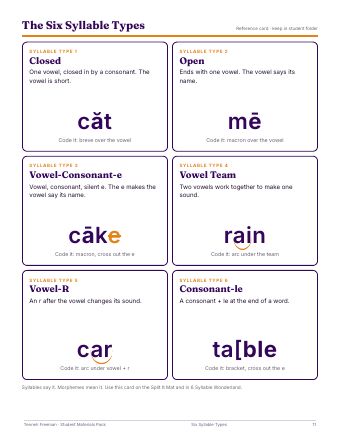
03SyllabicationBreaking longer words into syllables and knowing what each syllable type tells you to say.
04OrthographyThe spelling patterns and rules of written English.
05MorphologyPrefixes, roots, and suffixes: the parts of a word that carry meaning.
06SyntaxHow word order and grammar shape a sentence's meaning.
07Reading comprehensionBuilding and checking meaning from what you read.
08Reading fluencyReading with accuracy, a steady rate, and expression.
Simultaneous, multisensoryStudents see it, say it, hear it, and move with it at the same time: tapping, clapping, pushing counters, writing.
Systematic and cumulativeEach lesson starts with review and adds one new step, in a set order from simple to complex.
ExplicitI name the rule, model it, and think aloud. Students never have to guess what the pattern is.
Diagnostic teaching to automaticityExit checks and timed reads decide what I reteach the next day, until the skill is automatic.
1Warm-up
2Review
3New learning
4Guided practice
5Brain break
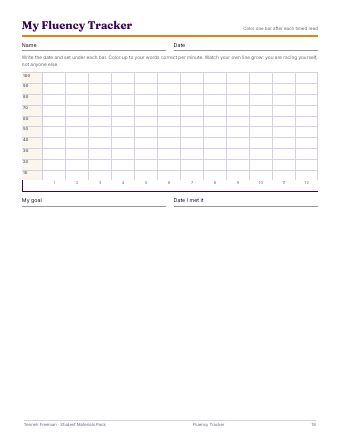
6Fluency
7Spelling
8Exit check
Sample lessons

Three lessons, second grade to high school

Each lesson has a minute-by-minute plan, TEKS alignment, an error correction script, a station rotation day, accommodations, and a progress monitoring rule. The bar shows how the minutes are spent.

Lesson 1 · Elementary · Grades 2–3

Open Door, Closed Door

Closed and Open Syllables · 30 minutes · Small group, 2–6 students

Why does the o in go say its name, but the o in got does not? The answer is a door.

Big idea. A closed syllable has one vowel closed in by a consonant, so the vowel says its short sound. An open syllable ends with one vowel: the door is open, so the vowel says its name.
Multisensory anchor. Door hands: one flat hand is the vowel, the other hand swings shut behind it for a closed syllable (short sound) or stays open for an open syllable (long sound).
TimeSegmentTeacher doesStudents doFocus
0:00–0:03Warm-up · Clap ItSay a word. Students repeat it and clap once per syllable, then hold up fingers for the count: hippo, cat, robot, basket, me.Repeat, clap, show the count. Then thumbs up for a long vowel sound, thumbs down for a short one: go, got, me, met.Phonological awareness
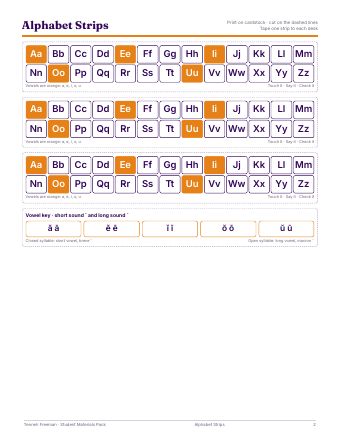
0:03–0:06Alphabet strip reviewStudents touch each vowel on the strip. Lead: short sound, then name (a says /ă/ and /ā/). Flash 8 letter cards for a quick sound check.Touch and say each vowel two ways. Say the sound for each card.Sound-symbol association
0:06–0:12New learning · Open Door, Closed DoorWrite me. Ask: is anything after the e? No, the door is open, so e says its name. Add t to make met: the t closes the door, so e is short. Model breve and macron. I do: me / met, go / got. We do: hi / hit, so / sob, she / shed. You do: no / not, we / wet on boards.Use door hands on every word. Write each pair, code the vowel, and read it.Explicit, multisensory
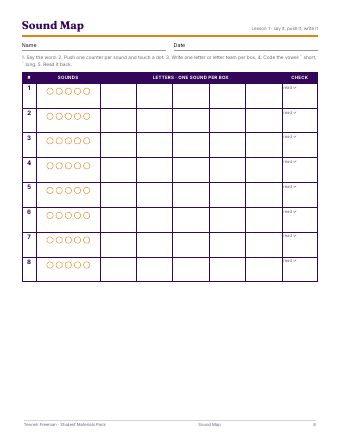
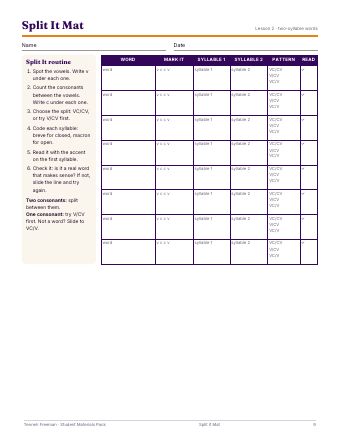
0:12–0:17Guided practice · Two-syllable wordsPut robot, napkin, music, and hotel on the board. Think aloud: find the vowels, split between syllables, code each one, read it. Students copy each word onto the sound map, one syllable per box.Mark the vowels, split, code ō / ŏ, and read: rō|bŏt, năp|kĭn, mū|sĭc, hō|tĕl.Syllabication
0:17–0:18Brain break · Stand Up, Sit DownCall 8 words. Stand for a word that ends with an open syllable; sit for a word that ends with a closed syllable.Move with the answer, then say the vowel sound.Movement
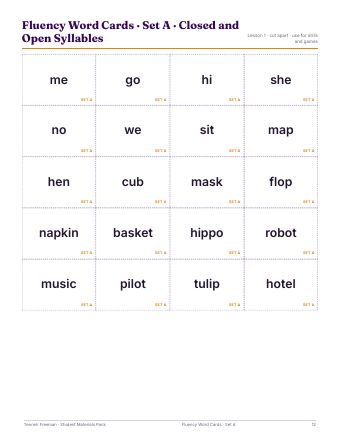
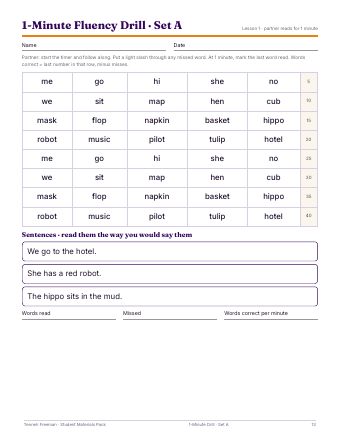
0:18–0:23Reading practice · Fluency Set AChoral read the card once with a finger under each word. Pair students: one reads, the other follows and marks any missed word. Switch.Read the 20-word card, then read the 3 sentences on the back.Reading fluency
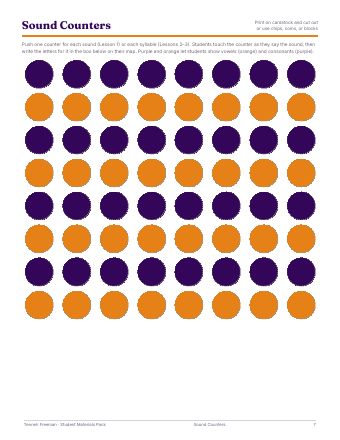
0:23–0:28Spelling · Counters and sound mapDictate hen, go, mask, robot, tulip. Routine: I say it, you say it, push one counter per sound, then write one letter (or letter pair) per box. Check with the alphabet strip. Dictate: She can go on a picnic.Say, push, write, check. Code the vowels in each word.Orthography
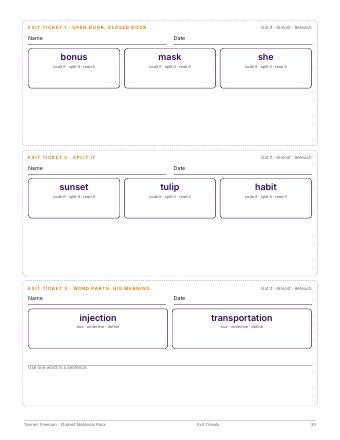
0:28–0:30Exit checkHand out Exit Ticket 1: code and read 3 words (bonus, mask, she). Sort tickets into Got It, Almost, and Reteach piles before tomorrow.Code and read each word to the teacher.Diagnostic teaching

Error correction. “Stop. Point to the vowel. Is a consonant closing the door? Then the vowel is short. Try it again.”

Objectives

  1. Given 10 one- and two-syllable words, students will label each syllable closed or open and mark its vowel with a breve (˘) or macron (¯), with 8 of 10 correct.
  2. Students will read the Set A fluency card (20 words) with at least 90% accuracy.
  3. Students will spell 4 of 5 dictated words using sound counters and a sound map.

TEKS alignment

2.2(A)(ii) / 3.2(A)(ii)Distinguish long and short vowel sounds; decode multisyllabic words with closed and open syllables.
2.2(C)(i) / 3.2(B)(i)Spell one-syllable and multisyllabic words with closed and open syllables.
2.4 / 3.4Use appropriate fluency (rate, accuracy, and prosody) when reading grade-level text.
2.6(F) / 3.6(F)Make inferences and use evidence to support understanding.

Dyslexia Handbook components

Phonological awarenessSound-symbol associationSyllabicationOrthographyReading fluencyReading comprehension

Materials

  • Alphabet strip (1 per student)
  • Sound counters (5 per student)
  • Sound map
  • Fluency Word Cards, Set A
  • Dry-erase board and marker
  • Open Door / Closed Door sort cards
  • Station passage: Meet the Hippo
  • Exit ticket 1

Key terms

  • closed syllable: one vowel, closed in by a consonant; short vowel
  • open syllable: ends in one vowel; long vowel
  • breve ˘: the mark for a short vowel
  • macron ¯: the mark for a long vowel

Station rotation day · 30 minutes, 3 stations × 10 minutes

Station 1
Teacher Table

Guided read of Meet the Hippo. Students find and code 4 target words in the text, then answer questions 1 and 2 aloud.

Station 2
Comprehension Station

Partners finish the Meet the Hippo question sheet: a detail, a text feature, an inference, and a vocabulary question.

Station 3
Word Work Station

Open Door / Closed Door card sort, or Levels 1 and 2 of 6 Syllable Wonderland on a device.

MinutesGroup 1Group 2Group 3
0–10Teacher TableComprehension StationWord Work Station
10–20Comprehension StationWord Work StationTeacher Table
20–30Word Work StationTeacher TableComprehension Station

Accommodations

  • Directions read aloud and repeated; one step on the board at a time.
  • Passages offered with audio or teacher read-aloud on the first read.
  • Target words highlighted; passages chunked by section.
  • Reduced copying: word lists and sentence frames provided.
  • Oral responses accepted on comprehension questions.
  • Timed reads are compared with the student's own baseline, not a class norm, and untimed practice always follows.
  • Clean, larger font with extra line spacing on all student pages.
  • Frequent check-ins and specific praise for effort and strategy use.

Progress monitoring

Coding accuracy on the exit ticket (target 80%) and words read correctly on Set A (target 90%). Below 80% on the exit check means tomorrow starts with a reteach of open versus closed using 4 word pairs instead of new learning.

Comprehension stations

Ten-minute reads with five questions

Each lesson has an original informational passage loaded with that lesson's word patterns. The five questions follow the same order every time: a detail, a text feature or structure, an inference with evidence, a vocabulary word in context, and word work on the lesson's pattern.

Lesson 1 · Grades 2–3

Meet the Hippo

Animal Profile

A hippo is a big animal. It lives in Africa. A hippo can sit in a pond or a river all day. The mud and the water help it stay cool in the hot sun.

Did You Know? The word hippo comes from a Greek word that means river horse.

Words to know: hippo · calf · land

Read the full passage

Where Hippos Live

A hippo is a big animal. It lives in Africa. A hippo can sit in a pond or a river all day. The mud and the water help it stay cool in the hot sun.

What Hippos Do

Hippos rest in the water when the sun is hot. At night, they go up on land to eat grass. A hippo can eat a lot of grass in one night! Hippos can not swim like fish. They walk on the bottom of the pond and pop up to get air.

Baby Hippos

A baby hippo is called a calf. A mom hippo and her calf stay close. The calf can drink milk under the water. Hippos look slow, but on land they can run fast!

Station questions (5)
1 · DetailWhere do hippos go at night? What do they do there?
2 · Text featureWhich section tells you about baby hippos? Write the heading.
3 · InferenceWhy do you think hippos stay in the water when the sun is hot? Use a clue from the text.
4 · Vocabulary"A baby hippo is called a calf." What is a calf?
5 · Word workFind 2 closed-syllable words and 2 open-syllable words in the text. Code each one.
Lesson 2 · Grades 4–6

Mae Jemison

Biography Profile · Doctor, Engineer, Astronaut

Mae Jemison was born on October 17, 1956, in Decatur, Alabama. When she was three, her family moved to Chicago, Illinois, the city she calls her hometown. As a kid, Mae loved science, dance, and looking up at the stars. She finished high school in 1973 and went to Stanford University in California when she was just 16 years old.

Did You Know? During the eight-day mission, Endeavour circled Earth 127 times.

Words to know: engineering · Peace Corps · mission · astronaut

Read the full passage

Early Life

Mae Jemison was born on October 17, 1956, in Decatur, Alabama. When she was three, her family moved to Chicago, Illinois, the city she calls her hometown. As a kid, Mae loved science, dance, and looking up at the stars. She finished high school in 1973 and went to Stanford University in California when she was just 16 years old.

Big Steps

At Stanford, Jemison earned a degree in chemical engineering in 1977. She also completed the requirements for a degree in African and Afro-American Studies. Next, she went to medical school at Cornell University and became a doctor in 1981. From 1983 to 1985, she served in the Peace Corps as a medical officer in Sierra Leone and Liberia, two countries in West Africa. She cared for volunteers and helped with medical research.

Into Space

In 1987, NASA picked Jemison to train as an astronaut. On September 12, 1992, she flew into space on the space shuttle Endeavour. She was the first African American woman to travel into space. The mission lasted eight days, and she worked on science experiments, including one that studied bone cells.

After NASA

Jemison left NASA in 1993. Since then, she has started projects that connect science, technology, and people, and she speaks to students about following their curiosity.

Facts from NASA's astronaut biography of Mae C. Jemison.

Station questions (5)
1 · DetailIn what two countries did Jemison serve with the Peace Corps?
2 · Text featureIn which section can a reader find out where Jemison went to college?
3 · InferenceJemison studied engineering, medicine, and African and Afro-American Studies. What can you infer about her interests? Use evidence from the text.
4 · Vocabulary"She served in the Peace Corps as a medical officer." What does served mean in this sentence?
5 · Word workFind 3 two-syllable words in the text. Split and code each one.
Lesson 3 · Grades 7–12

When Earth Erupts

Science and Geography Profile

A volcano is an opening in Earth's crust. Deep below it, melted rock called magma collects in a chamber. Gas builds up inside the magma, the way pressure builds inside a shaken bottle of soda. When the pressure becomes too great for the rock above it, the surface ruptures and the volcano erupts.

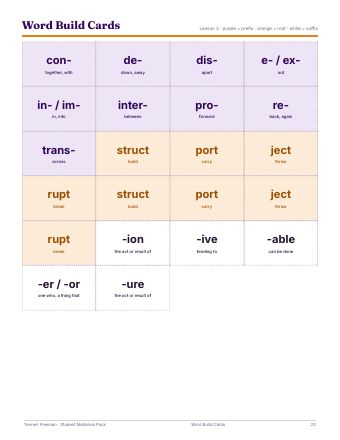
Word Parts Erupt, rupture, disrupt, and interrupt all share the Latin root rupt, which means break.

Words to know: magma · atmosphere · jet stream · evacuation

Read the full passage

Inside the Structure

A volcano is an opening in Earth's crust. Deep below it, melted rock called magma collects in a chamber. Gas builds up inside the magma, the way pressure builds inside a shaken bottle of soda. When the pressure becomes too great for the rock above it, the surface ruptures and the volcano erupts.

The Eruption

During an eruption, a volcano can eject lava, gas, and pieces of rock. Some of these rock fragments are projected through the air like stones from a slingshot. Fine ash can be thrown kilometers into the sky, where wind can carry it far from the volcano.

Ash That Stopped the Sky

In April 2010, a volcano in Iceland called Eyjafjallajökull erupted under a glacier. It ejected fine ash more than 8 kilometers into the atmosphere, and the jet stream transported the ash cloud toward Europe. Because ash can damage jet engines, airports shut down. Between April 14 and 21, about 100,000 flights were canceled and some 7 million travelers were stranded. Guinness World Records lists it as the biggest climatic disruption to air travel.

Rebuilding

Eruptions can destroy roads, bridges, and power lines: the infrastructure a community depends on. Engineers study each eruption so they can construct stronger structures and plan safer routes. Communities near volcanoes practice evacuation plans, so when the next eruption interrupts daily life, people know where to go.

2010 figures from Guinness World Records, Biggest climatic disruption to air travel.

Station questions (5)
1 · DetailWhat caused airports across Europe to close in April 2010?
2 · Text structureHow does the author explain why a volcano erupts in Inside the Structure? Name the structure and the comparison the author uses.
3 · InferenceWhy do you think engineers study each eruption? Use evidence from the text.
4 · Vocabulary"The jet stream transported the ash cloud toward Europe." Use word parts to define transported.
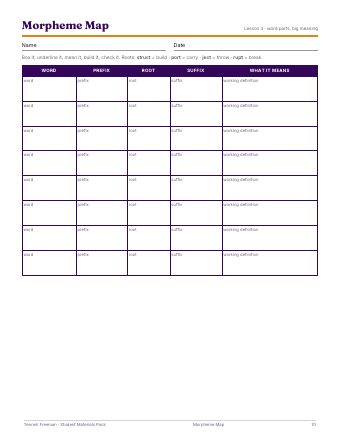
5 · Word workFind 4 words with struct, port, ject, or rupt. Box the affixes, underline the root, and write a working definition.
Brain breaks and activities

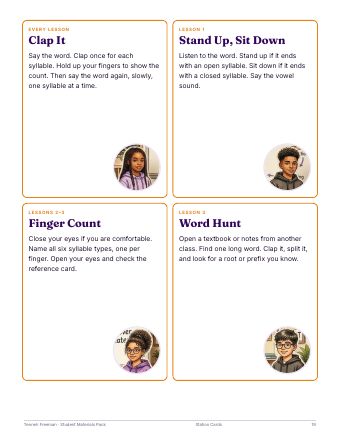
Clap it. Count it. Split it.

Short movement and recall breaks sit at the seams of every lesson. Try the Clap It pad: tap once per syllable, then check.

hippo
Taps 0
Clap ItClap once per syllable, then show the count on your fingers.
Stand Up, Sit DownStand for an open syllable, sit for a closed one.
Finger CountName all six syllable types, one per finger, from memory.
Word HuntFind a long word in another class's textbook and split it.
Student materials

Everything the students touch

Desk tools, maps and mats, fluency cards, station cards, passages, and exit tickets, ready to print on letter paper.

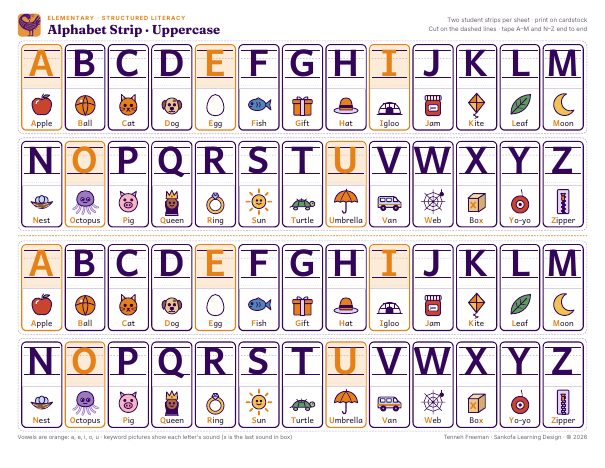
Preview: elementary picture alphabet strip, uppercase
Elementary picture alphabet stripsUppercase and lowercase on handwriting lines, with a keyword picture for every letter sound. Two student strips per sheet.
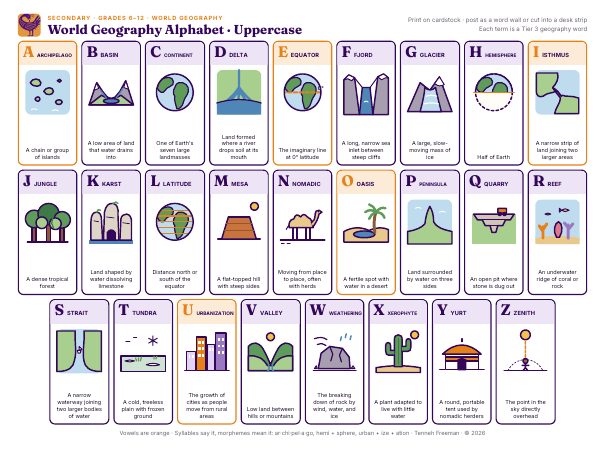
Preview: World Geography alphabet, uppercase
World Geography alphabetUppercase and lowercase cards for secondary students: archipelago to zenith, each with a picture and a plain definition.
Word work station

6 Syllable Wonderland

Six doors, one per syllable type. Amara, Jalen, Zuri, and Kai teach each type, then students clap it, sort it, and split it. Each room reviews the types before it, and a Sankofa bird marks every room finished. The final room uses long words from science, math, and social studies.

Open the hallway
AmaraClosed · Open
JalenSilent-e · Team
ZuriVowel-R · -le
KaiFinal room